Showing posts with label Kansas. Show all posts

Saturday, July 12, 2008


I grew up in Gypsum, population around 400 people. The tiny Saline County town doesn't have much -- a hardware, a gun store and a part-time gas station.

We do have a red sign on the edge of town proclaiming our only claim to fame: Steve Fritz.

I don't personally know Steve. I know his dad, Pee Wee, who runs the part-time gas station and who fixed my green Ford pickup numerous times. Faded, on the side of the old Phillip's 66 station, is a tribute to his son and the town's people who supported him in the 1996 Summer Olympic Games in Atlanta.

Steve competed in the Dan O'Brien era -- you know, the guy in the Dave and Dan commercials. He narrowly missed an Olympic bronze, instead finishing fourth.

No medal, but still, how cool is that.

So earlier this week, when I took a one-tank trip to the Kansas Sports Hall of Fame, I wasn't surprised to see Steve's Olympic warm up, or pictures of him on display. He's just one of Kansas' athletic greats -- along with Barry Sanders, Lynette Woodard, Wes Santee and Thane Baker.

On a side note, I was so excited to get to interview two Olympic greats, Thane and Wes were overly nice. And to reiterate what they told me, they recommend a trip to the hall of fame.

So do I.

Wednesday, July 2, 2008

Day trip will transport you to a people's past

Amy Bickel
The Hutchinson News
abickel@hutchnews.com

COUNCIL GROVE - Take a walk along the Kanza Heritage Trail, past a monument, ruins of huts and a reconstructed earth lodge.

It's here the Kaw Indians lived for more than 25 years, as well as a vice president.

The monument is visible from the paved county road - sitting high on a hill in the middle of a stretch of tallgrass prairie that waves with the stiff Kansas breeze.

Underneath lie the remains of an unknown Indian, a warrior who died before his tribe's forced migration to Oklahoma - a tribe that once existed on this parcel of land in the state that bears their name.

Yet the story lives on here amid the flint rock and blooming wildflowers.

It's the story of how a tribe reclaimed a parcel of land - 158 acres of it - in an effort to preserve and educate others about their trials, tribulations - their heritage.

Kaw history
At one time, the Kaw Nation stretched over 20 million acres across northern Kansas into Nebraska and Missouri.

In 1825, the Kaw signed a treaty to move to a reservation near present-day Topeka. In 1846, the Kaw signed another treaty and moved to the Council Grove area, selling their 2 million-acre reservation for a little more than 10 cents an acre.
They lived in the Council Grove area for 25 years before the government decided to move them again, said Linda Poston, with Council Grove's Kaw Mission State Historic Site.
On June 4, 1873, the Kaw's last forced migration began and was completed 17 days later. What was once a tribe plentiful in number had dwindled to 600 when it finally moved to its present-day reservation in Oklahoma.
Then, about 130 years later, in 2000, the Kaw returned to Kansas, back to their homeland, purchasing 158 acres they turned into Allegawaho Heritage Memorial Park.
"It can be a rather spiritual experience when you go out there usually - hawks flying overhead and a few miles of trail and not many people," said Ken McClintock, a local historian who runs the Trail Days Bakery and Cafe.

Indian skeleton
Those who make the trip to the heritage park can see the remains of a Kaw Agency and ruins of three of the 138 stone huts the federal government built for the Kaw, although they never lived in the huts, he said.
Visitors also can travel a two-mile Kanza Heritage Trail around the former reservation.
The trail winds around the Flint Hills, past Little John Creek and eventually around the monument.
During the summer of 1924, a group of Boy Scouts discovered the skeleton of the Kaw warrior, McClintock said. The Smithsonian wanted the find, but landowner Frank Haucke told officials the Indian belonged at the site.
The Haucke family gave money for the construction of the monument, which was dedicated by the Kaw during a weeklong ceremony in 1925.
In 1929 or 1930, Vice President Charles Curtis, the most famous member of the Kaw tribe who lived on the reservation for a time with his grandparents, laid a wreath at the site, McClintock said.

Good day trip
About 90 minutes southwest of Topeka in Morris County, Council Grove makes a great day-trip destination.
Once a bustling rendezvous point on the Santa Fe Trail, Council Grove today attracts those of a different sort - tourists eager to relive the trail days' spirit.
"We have more Santa Fe Trail historic sites than any other town along it," McClintock boasts.
Visitors can see Council Oak, where, in 1825, a treaty was signed with the Osage Indians, ensuring safe travel for white settlers.
The Hays House, built in 1857, is the oldest continuously operated restaurant west of the Mississippi River.
Fading Santa Fe Trail ruts are still visible. Other sites include the trail's Neosho River crossing and the Post Oak, the unofficial post office for travelers on the Santa Fe Trail from 1825 to 1947.
Council Grove makes a good one-day trip, or even two, said Jeanine Bacon, who helps run Aldrich Apothecary, a full-service pharmacy with an early 1920s soda fountain.
"With the Kaw, with the trail, there's a lot of history here," she said. "It's a good trip for one tank of gas."

Friday, June 27, 2008

The Kaw of Council Grove


About a half decade ago, I met with the Kaw on the hill where the monument to an unnamed Indian sits.

Their idea was intriguing-- to turn their former home into a historic place -- a learning center and nature trail that could be a potential draw for the Council Grove area.

It's here the Kaw Indians lived for more than 25 years, as well as a vice president. The monument is visible from the paved county road - sitting high on a hill in the middle of a stretch of tallgrass prairie that waves with the stiff Kansas breeze.

Council Grove already is deep in Native American history. Each year, they have a festival honoring the last Kaw Indian chief. A trail and heritage park on an old reservation would just add to the town's story.

About a year later, I attended their ceremony, dedicating the Allegawaho Heritage Memorial Park and the future site of the Kanza Heritage Trail.

I hadn't been back since until I went for a one-tank trip. I figured it would be more developed, but to my surprise, not much had changed.

There were no signs leading to the site. I found it easily, although I stopped at the gas station to see which road to take, and then had to look for the monument, which sticks out fairly well on the hill.

Pulling up to it, you might think you are going to wander on private property. And there isn't much parking. I recommend parking at the stone house then walking down the dirt road to the entrance.

I didn't walk far on the trail, although I'd like to go back and do so someday. Storm clouds darkened the sky. For some reason, I feared being alone, and being bit by a snake hiding under one of those flint rocks.

And no cars drove by this patch of Flint Hills. I was in the middle of nowhere.

Still, it is a good trip. I recommend taking a walk along the Kanza Heritage Trail, past the monument, ruins of huts and a reconstructed earth lodge.

Friday, May 30, 2008

Marquette legend's career on display


Stan Engdahl died last year. He was a great tour guide when I went to Marquette for a one-tank trip in July 2007. His legacy, however, lives on through the Kansas Motorcycle Museum, and it still is very interesting if you enjoy racing sports and motorcycles. The museum added an addition this year to display more items. Stan's wife still is a curator.

What I enjoyed the most was the Indian motorcycle and seeing the old pictures on the wall. I also was amazed that Stan won a race at Sturgis. Most of his trophies are on display.

If you go, be sure to stop by the cafe, which is run by a British woman. I have a passion for soda fountains. City Sundries on Main Street probably doesn't rank up as one of the top fountains I've stopped at, but it's worth walking in the door.

About 10 miles to the west is Kanopolis Lake, and 10 miles to the east is Lindsborg.

July 22, 2007


Marquette legend's career on display

By Amy Bickel
The Hutchinson News
abickel@hutchnews.com


MARQUETTE - In a storefront on Main Street in this tiny town of 600, a white-haired man sits behind a desk, waiting.

He waits for the next person to open the door, the next person to tell the story of Stan the Man and the story of why the townspeople of Marquette turned a dilapidated old building into a motorcycle museum in honor of the local celebrity.

A fearless racer, they called him. A guy whose trophies number more than 600 and who five times won enough titles in a year to reign as national racing champion. He also has 16 state championships.

That's why they dubbed him Stan the Man.

"That's what they called me," the white-haired man named Stan Engdahl said of his motorcycle-racing career that spans a half-century.

A Kansas racing legend, Engdahl retired from racing in 1997. It didn't take long for townspeople in his McPherson County hometown to decided to renovate his former television repair shop and turn it into the Kansas Motorcycle Museum. It opened in 2003.

Evidence of Engdahl's career spans the building, everything from photos and trophies to his custom-built racing Harley. More than 100 donated motorcycles fill the museum. That includes a 1916 Harley Davidson, a 1958 Cushman Scooter, a 1922 Indian, a 1928 Cleveland and a 1994 Russian Ural. But Engdahl might be the biggest draw.

Engdahl and his wife, LaVona, are the curators, manning their posts seven days a week. Just pick a trophy, and he'll tell you the story. For instance, he won his first race in 1948 on a track near Salina. He became hooked. "My mother didn't like it," he admits. He won Sturgis' Jackpine Gypsies in 1968.

In 1962, he won the state championship with a broken leg. Engdahl broke two bones in his lower leg six weeks before the race. Organizers made him sign a release to participate. His doctor told him to be careful.

"I was," Engdahl said. "I never fell off."

Good day trip
Even Engdahl didn't know the effect his racing would eventually have on Marquette. While the neighboring town of Lindsborg capitalizes on its Swedish heritage, Marquette cashes in on motorcycle tourism, said Steve Piper, who owns the town grocery store and served as mayor 14 years.

Stephen McGee opened Steve's British Bike Museum - a hybrid museum and motorcycle shop - in 2005. In addition, a motorcycle rally in May brings 3,000 to 5,000 people to town and enough bikes to line both sides of Main Street.

"We built the museum for one reason, to help the town, to bring visitors to town," Piper said. "We've had thousands come through it."

It also makes a good day trip. Folks can go to downtown gift shops, have a soda at the sundries, visit the British bike museum and eat lunch at a local establishment.

"It's been a great boost for Marquette," Piper said. "It's helped some businesses in town. It's one of the best things we've done for Marquette, anyway."

Thursday, May 29, 2008

Dead artist, his work still a big draw


Here's one of the first one-tank trips from the 2007 series. For those who haven't been to Lucas' Garden of Eden, I'd highly recommend it. My favorite part of this whole story was interviewing Dinsmoor's 79-year-old son, who is a successful professional and lives in Colorado.

For the most part, Lucas and the Garden's owners have kept the site up in good shape.

If you go, Lucas is known for its artists. There's plenty of sculptures and pieces around town, including the World's Largest Travel Plate, which welcomes you into town.


July 29, 2007

A century after it all began and 75 years after his death,
Lucas' Dinsmoor and his works of art are still on display.

By Amy Bickel
The Hutchinson News
abickel@hutchnews.com

LUCAS - You need a flashlight to see S.P. Dinsmoor.

"He's getting kind of moldy," admits tour guide Samantha Schneider as she shined her flashlight toward his head.

His body has shrunken and the black suit he was buried in is rotting. However, even 75 years after his death, folks can look through the glass-sided tomb and see the decomposing creator of Lucas' Garden of Eden.

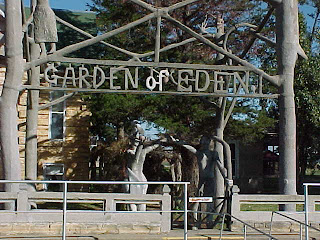
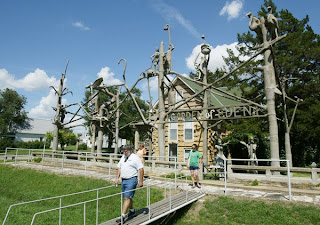
He's a creator townsfolk heckled as he poured 113 tons of concrete to form one of Kansas' most famous works of art - one that surrounds a little limestone house in this town of 400.

At least, it is the most unusual.

A concrete Adam and Eve greet visitors. Above them, the devil, storks and frolicking children reside. Cain murders Abel, angels, serpents and a watchful eye of the all-seeing deity also are among the 150 sculptures in his garden. It still attracts the curious from around the globe, and Dinsmoor is still there, on display for the world to see if they choose.

Dinsmoor was a Civil War veteran, schoolteacher, farmer, Populist thinker and a forerunner in grassroots art. He started building the limestone cabin home in 1907 at the age of 64, working 22 years on his project until he could no longer see. He died July 21, 1932.

"Not only is it an impressive accomplishment for a retired man to put together, it also is an educational resource for those interested n the history of the Great Plains," said Jon Blumb, Lawrence photographer and president of the Garden of Eden Inc., a group of a dozen or so shareholders who purchased the garden in 1989.

Biblical scenes mingle with political messages. In the back yard, Labor is crucified while Banker, Lawyer, Preacher and Doctor give their approval. On another pillar, an octopus represents monopolies and grabs at the world while a soldier and child are trapped in two of its tentacles. Another concrete tree shows the Goddess of Liberty driving a spear through the head of another octopus and freeing citizens.

"The Goddess of Liberty, the octopus, they are like the typical political cartoons of the time period," Blumb said, adding that the message for America remains relevant today. "Our political situation nowadays could use him," he said. "I'd vote for him."

Today, the Garden of Eden draws thousands to this tiny Russell County town, including grassroots artists like Dinsmoor.

"He didn't even know what that was, but he has been an inspiration for a lot of people," Blumb said of the art movement. "But how could you live in Lucas and not be influenced by Dinsmoor?"

Yet, beyond the tons of concrete, political messages and oddities, the garden's finishing piece is Dinsmoor himself. He built a 40-foot-tall limestone log mausoleum for himself and his first wife. She died in 1917. He remarried a 20-year-old at age 81, had two children, and then died.

His second wife executed his final wishes - to be buried in the mausoleum, his body visible inside the glass-topped concrete coffin and to have visitors be charged at least $1 to see him, Blumb said. Today, the charge is $6 per adult.

An air leak discovered a few years ago has sped up the corpse's decomposing process, tour guide Schneider said.

Dinsmoor's son John, also the youngest living son of a Civil War veteran, said he makes the journey every few years to the garden and the tomb. His father died when he was 4. He lived there until he was 13, however, when his mother sold the property to pay back taxes.

Now 79, John Dinsmoor said he didn't mind seeing his father during his periodical visits.

"I get to look at him eyeball to eyeball," he said. "He's pretty well decomposing, and he's still making money."